15 abr 2014

13 abr 2014
A DRAMATIC EDUCATION SITUATION

Without cross-party consensus, Spanish students will never bridge the gap that separates them from the best performers EL PAÍS 4 ABR 2014
Time and again, the PISA report has warned that the educational level of Spanish students is far from what it should be. If earlier testing yielded mediocre results in mathematics, science and reading proficiency, the latest evaluation shows that results are even worse when it comes to practical skills.
Faced with questions that measure one’s ability to deal with everyday things such as programming an air conditioner or purchasing a combined public transit ticket, Spanish 15-year-olds scored 23 points below the average for OECD countries and 30 points below France, Italy and Germany. This is a dramatic situation about which the relevant officials do not seem fully aware.
Too much time has been lost —for too many years— on sterile ideological fights regarding the role of religion at school or the values it should teach, instead of seeking the necessary consensus to produce the changes that education in this country really needs. No reform has been able to redress the situation, and it remains to be seen whether the latest one will bring about any substantial changes.
What is needed is a “radical change in teaching methodology,” said the state secretary of education, to move beyond “old-fashioned” models based solely on memorizing content. What the PISA report suggests is that students must be given the necessary skills to apply the knowledge that they gain; the important thing is not how much you know, but what you are able to do with what you know, and being capable of learning what you still do not know.
But with a dispirited, decimated teaching community that has few options for career reinvention, it will be difficult to overcome the inertia that has led to the current results. Education once required – and still does – the kind of cross-party consensus that will pave the way for a reliable diagnosis of our system’s shortcomings and required changes.
In the first place, we urgently need much more of an educational focus on developing personal abilities and creative skills. Secondly, we need measures to reinforce the teachers’ work through programs aimed at improving their own teaching abilities and helping student stragglers meet class goals. Without extraordinary measures, it will be difficult to bridge the gap separating us from the best performers.
Find expressions in the text that mean the following:
- acortar distancias:
- una y otra vez/ reiteradamente:
- cuando se trata de...:
- parecer plenamente conscientes:
- queda por ver:
- consenso entre partidos:
- allanar el camino, preparar el terreno:
- deficiencias:
- alumnos rezagados:
- lograr los objetivos:
Now find synonyms of the following:
- produce, give:
- buy:
- beneath, under:
- in relation to, concerning:
- rather than:
- important:
- exclusively:
- disillusioned, disheartened<.
- destroyed:
- win, surmount:
- present, most recent:
- able to be trusted:
- failing, defect, deficiency:
- have as a goal:
Spanish students lagging behind in problem solving, PISA report shows
Low scores do not reflect 15-year-olds’ theoretical skills in math, reading and science
Spanish 15-year-old students come out 23 points below average among developed economies in ordinary problem-solving skills, according to the latest Program for International Student Assessment (PISA) report, a triennial study conducted by the Organisation for Economic Co-operation and Development (OECD).
The performance by the 2,709 Spanish students who participated in the program – which evaluated 85,000 youngsters from 44 countries – shows that they are less well prepared to tackle the problems of everyday life than their scores in math, reading and science would suggest.
Their problem-solving skills were 20 points below those expected based on their theoretical knowledge. In other words, they are unable to use what they learned.
“The world economy does not focus on what one knows, but on what one can do with what one knows,” noted the OECD’s education chief, Andreas Schleicher, who traveled to Spain to present the test results.
“What’s needed is a radical change in the teaching methodology,” added Montserrat Gomendio, state secretary for education, during the presentation of the report. Gomendio said current methods were “old-fashioned” and based only on memorizing content. Responsibility for this change, she said, falls mostly on the shoulders of teachers.
The PISA report shows that 28 percent of Spanish 15-year-olds failed to reach a minimum baseline level of proficiency in problem solving, compared with a 21-percent OECD average. Spain obtained a mean score of 477 points (500 is the OECD average), ranking between 27th and 31st out of 44. The list leaders are Singapore and South Korea with 562 and 561 points, respectively.
The children of very educated parents perform worse than expected, the study finds
Spain is dragged back by several factors. First there is the fact that the difference between problem solving by kids from low and high socioeconomic backgrounds is not nearly as marked as in other countries: 42.7 points compared with an average of 68.8. In other words, the children of highly educated parents perform worse than expected, bringing the average down. State secretary Gomendio said the “rigidity” of the education system establishes “an equity which is taken to mean that everyone must be uniformly mediocre.”
The high rate of students who repeat a grade (33.2 percent compared with the OECD average of 17 percent) also brings the scores down. Without them, Spanish students would obtain a score of 512 points, in line with the OECD average.
The PISA report notes that Spanish students seem unfamiliar with computer use, based on their digital reading scores. Yet 96.6 percent of Spanish teenagers have a computer at home, and 75.3 percent use computers or tablets in their houses, five points above the OECD average.
Spanish 15-year-old students come out 23 points below average among developed economies in ordinary problem-solving skills, according to the latest Program for International Student Assessment (PISA) report, a triennial study conducted by the Organisation for Economic Co-operation and Development (OECD).
The performance by the 2,709 Spanish students who participated in the program – which evaluated 85,000 youngsters from 44 countries – shows that they are less well prepared to tackle the problems of everyday life than their scores in math, reading and science would suggest.
Their problem-solving skills were 20 points below those expected based on their theoretical knowledge. In other words, they are unable to use what they learned.
“The world economy does not focus on what one knows, but on what one can do with what one knows,” noted the OECD’s education chief, Andreas Schleicher, who traveled to Spain to present the test results.
“What’s needed is a radical change in the teaching methodology,” added Montserrat Gomendio, state secretary for education, during the presentation of the report. Gomendio said current methods were “old-fashioned” and based only on memorizing content. Responsibility for this change, she said, falls mostly on the shoulders of teachers.
The PISA report shows that 28 percent of Spanish 15-year-olds failed to reach a minimum baseline level of proficiency in problem solving, compared with a 21-percent OECD average. Spain obtained a mean score of 477 points (500 is the OECD average), ranking between 27th and 31st out of 44. The list leaders are Singapore and South Korea with 562 and 561 points, respectively.
The children of very educated parents perform worse than expected, the study finds
Spain is dragged back by several factors. First there is the fact that the difference between problem solving by kids from low and high socioeconomic backgrounds is not nearly as marked as in other countries: 42.7 points compared with an average of 68.8. In other words, the children of highly educated parents perform worse than expected, bringing the average down. State secretary Gomendio said the “rigidity” of the education system establishes “an equity which is taken to mean that everyone must be uniformly mediocre.”
The high rate of students who repeat a grade (33.2 percent compared with the OECD average of 17 percent) also brings the scores down. Without them, Spanish students would obtain a score of 512 points, in line with the OECD average.
The PISA report notes that Spanish students seem unfamiliar with computer use, based on their digital reading scores. Yet 96.6 percent of Spanish teenagers have a computer at home, and 75.3 percent use computers or tablets in their houses, five points above the OECD average.
http://elpais.com/elpais/2014/04/01/inenglish/1396364218_557397.html
READ BOTH TEXTS AND ANSWER THE FOLLOWING QUESTION:
According to the previous articles, what are the main reasons for the bad results? What needs to be done?
THEN POST YOUR OPINION
READ BOTH TEXTS AND ANSWER THE FOLLOWING QUESTION:
According to the previous articles, what are the main reasons for the bad results? What needs to be done?
THEN POST YOUR OPINION
2 abr 2014
THE STORY OF LENA BAKER

As a child Baker and her family worked for a farmer named J. A. Cox chopping cotton. They were not paid well and even working in a laundry, the family was poor.
At the age of 20, Baker and a black friend found they could make money by "entertaining gentlemen." This came to attention of the Randolph County sheriff as their clientelle were white and interracial relationships were illegal in Georgia.
The two were arrested and spent several months in a workhouse. On release she was ostracized by the black community, leading her to become an alcoholic.
In 1941, Baker was hired by Knight to care for him after a fall broke his leg. In the town of Cuthbert, Georgia, Knight was viewed as brutal and abusive. He was a failed farmer who ran a gristmill. He always had a pistol strapped to his chest.
A relationship developed between the two. Knight would provide Baker with alcohol in return for sex, and the whole town knew of it. Knight was persuaded by his oldest son to move to Tallahassee, Florida in an effort to break up the pair, but Baker came with him. Knight's oldest son then gave Baker an ultimatum to leave. She did, but Knight followed her back to Cuthbert.
On the night of April 30, 1944 Lena Baker went to the house of J.A. Cox, who was now the town coroner and told him that she had shot Knight. Cox told Baker to go to the sheriff, while he would go to gristmill where Baker said Knight's body was. Baker did not go to the sheriff, but instead went home. She was picked up by the sheriff later that night, but was cooperative. He gave her two days to sleep off the effects of the alcohol in her system.
Baker then told her version of events. Knight had come to her house drunk and asked her to come to the mill. She did not want to, but knew better than to refuse the drunk man. She tried stalling him by asking for money to go buy some whiskey.
He gave her some money and she went to the tavern but found it closed. She waited there for a while hoping that Knight would leave her house. She returned but found he was still there. She was forced to accompany him to the mill, but escaped and hid in some bushes. She bought some whiskey and went to sleep at the nearby convict camp. On waking the next morning she decided to go to the mill and she was sure this was the last place that Knight would go.
However this was exactly where Knight was. He held her prisoner for several hours, even though several hours of his absence. He returned and told Baker he would kill her before she would ever leave again. A struggle ensued, with Baker being the only living witness the details of what happened are sketchy at best but Baker managed to get hold of Knight's pistol, which went off, hitting him in the head, instantly killing him.
Although Knight was not liked in the town, a white man had been killed by a black woman, something that was intolerable to the segregationist townsfolk.

Lena Baker was charged with capital murder and stood trial on August 14, 1944, presided over by Judge William "Two Gun" Worrill, who kept a pair of pistols on his judicial bench in plain view. The all-white male jury convicted her by the end of the afternoon. Her court-appointed counsel, W.L. Ferguson, filed an appeal but then dropped Baker as a client. Governor Ellis Arnall granted Lena a 60-day reprieve so that the Board of Pardons and Parole could review the case, but clemency was denied in January 1945. Baker was transferred to Reidsville State Prison on February 23, 1945.
On entering the execution chamber, Baker calmly sat in the electric chair, called Old Sparky, and said "What I done, I did in self-defense, or I would have been killed myself. Where I was I could not overcome it. God has forgiven me. I have nothing against anyone. I picked cotton for Mr. Pritchett, and he has been good to me. I am ready to go. I am one in the number. I am ready to meet my God. I have a very strong conscience." Initially she was buried in an unmarked grave behind Mount Vernon Baptist Church. Since her pardoning a simple head stone has been placed above her grave.
In 2001, members of Baker's family petitioned to have a pardon granted by the Georgia Board of Pardons and Paroles, seeing the original verdict as racist. This was granted in 2005, with the Parole Board granting her a full and unconditional pardon, suggesting a verdict of manslaughter, which would have carried a 15-year sentence.
ELECTROCUTION
For execution by the electric chair, the person is usually shaved and strapped to a chair with belts that cross his chest, groin, legs, and arms. A metal skullcap-shaped electrode is attached to the scalp and forehead over a sponge moistened with saline. The sponge must not be too wet or the saline short-circuits the electric current, and not too dry, as it would then have a very high resistance. An additional electrode is moistened with conductive jelly (Electro-Creme) and attached to a portion of the prisoner's leg that has been shaved to reduce resistance to electricity. The prisoner is then blindfolded. After the execution team has withdrawn to the observation room, the warden signals the executioner, who pulls a handle to connect the power supply. A jolt of between 500 and 2000 volts, which lasts for about 30 seconds, is given. The current surges and is then turned off, at which time the body is seen to relax. The doctors wait a few seconds for the body to cool down and then check to see if the inmate's heart is still beating. If it is, another jolt is applied. This process continues until the prisoner is dead. The prisoner's hands often grip the chair and there may be violent movement of the limbs which can result in dislocation or fractures. The tissues swell. Defecation occurs. Steam or smoke rises and there is a smell of burning
U.S. Supreme Court Justice William Brennan once offered the following description of an execution by electric chair:
...the prisoner's eyeballs sometimes pop out and rest on [his] cheeks. The prisoner often defecates, urinates, and vomits blood and drool. The body turns bright red as its temperature rises, and the prisoner's flesh swells and his skin stretches to the point of breaking. Sometimes the prisoner catches fire....Witnesses hear a loud and sustained sound like bacon frying, and the sickly sweet smell of burning flesh permeates the chamber.
1 abr 2014
Phaedophile priest Francis Paul Cullen jailed for 15 years
Paedophile priest Francis Paul Cullen jailed for 15 years
Priest who abused seven children, including altar boys, over 34-year period had pleaded guilty to 21 charges.

"Predatory" Francis Paul Cullen, 85, pleaded guilty to 21 charges of indecent attack and other sexual offences last month after being extradited to the UK last year following 22 years on the run in Tenerife. The offences were committed between 1957 and 1991 on children aged between six and 14.
Four altar boys were abused while Cullen was practising in Mackworth, Derbyshire, between the 1950s and 1970s. In the 1980s, he abused two girls after he moved to work in Buxton, Derbyshire, and then went on to abuse another altar boy in the early 1990s after he moved to Nottinghamshire. The clergyman fled to Tenerife in 1991 while facing charges of sexual assault brought by Nottinghamshire police.
Prosecutor Sarah Knight told the court that Cullen had been a "well-liked and respected" clergyman whom families trusted and children "idolised". They were unaware of the "predatory paedophile" hiding out behind the mask, Knight told the court.
Dublin-born Cullen was traced to Tenerife last year with the help of the Catholic Church’s safeguarding board. He was extradited back to the UK on a European arrest authorization containing a series of sexual abuse charges.
The clergyman was due to deny the charges at Derby crown court last month but changed his plea to guilty on what would have been the first day of his trial.
He admitted 15 counts of indecent assault, five of indecency with a child and one of attempted sodomy.
Synonyms
Extradited: deport, exile
Deny: contradict, dispute
Assault: aggression, invasion
Fled: escape, run away
Plea: supplication
Altar boy: a boy serving as an acolyte, who helps the priest
Facing: surface, revetment
Unaware: unknowing, unmindful
Trial: preliminary, probationary
Idolised: admired, adored, venerated
Attempted: tried, struggled
Traced: follow, pursuit, run down
Safeguarding: protection, preservation
Offences: crimes, faults
Extradited: deported, expelled
Prosecutor: investigator -lawyer
Summary
Priest Francis Paul Cullen. who was born in Berlin, has been accused of abusing children. He was living in Tenerife and was extradited back to the UK where he practised all sexuals harassments. Also people are surprised because they trust their children to him and they couldn't believe that this men was a phaedophile. Finally he has accepted 15 charges and at the present he will be in prison for 21 years.
Video
http://www.dailymotion.com/video/x1dbf9v_ex-priest-admits-child-sex-charges-xvid_news
by Ruth Alquinga, Alina Achig and Alexandra Pons
WORLD TRADE CENTER
SUMARY:
"9/11" were four terrorist attacks carried out by al-Qaeda, in which about 3000 people died. The terrorists hijacked four planes, two of which crashed into the upper floors of the North and South towers of the World Trade Center. There were very large fires that made the towers collapse. The terrorists had targeted the towers because they symbolize the economic power of the United States. The President of the United States insisted that the Taliban had to hand over terrorists immediately and close training camps or face an attack from the United States. When they refused, "Operation Enduring Freedom" was established a few days later.
ARTICLE:
“9/11” is shorthand for four coordinated terrorist attacks carried out by al-Qaeda, an
Islamist extremist group, that occurred on the morning of September 11, 2001. The attacks killed 2,977 people.
On the morning of September 11, 2001, 19 terrorists from the Islamist extremist group, al-Qaeda, hijacked four commercial airplanes, deliberately crashing two of the planes into the upper floors of the North and South towers of the World Trade Center complex and a third plane into the Pentagon in Arlington, Va. The Twin Towers ultimately collapsed because of the damage sustained from the impacts and the resulting fires. After learning about the other attacks, passengers on the fourth hijacked plane, Flight 93, fought back, and the plane was crashed into an empty field in western Pennsylvania about 20 minutes by air from Washington, DC.
The attacks killed nearly 3,000 people from 93 nations. 2,753 people were killed in New York, 184 people were killed at the Pentagon and 40 people were killed on Flight 93.
The hijacked Flight 11 was crashed into floors 93 to 99 of the North Tower (1 WTC) at 8:46 a.m. The hijacked Flight 175 struck floors 77 to 85 of the South Tower (2 WTC) 17 minutes later at 9:03 a.m. When the towers were struck, between 16,400 and 18,000 people were in the WTC complex. Of those, the vast majority evacuated safely. As they rushed out, first responders rushed in trying to save those still trapped or injured.
The fires from the impacts were intensified by the planes’ burning jet fuel. They weakened the steel support trusses, which attached each of the floors to the buildings’ exterior walls. Along with the initial damage to the buildings’ structural columns, this ultimately caused both towers to collapse. The five other buildings in the WTC complex were also destroyed because of damage sustained when the Twin Towers fell.
The collapse of the buildings left the site devastated, with ruins towering roughly 17 stories and spread beyond the 16-acre site. Thousands of volunteers came to Ground Zero to help with the rescue, recovery and clean-up efforts, and on May 30, 2002, the last of piece of WTC steel was ceremonially removed.
The terrorists did not have capacity to destroy the United States militarily, so they set their sights on symbolic targets instead. The Twin Towers, as the centerpieces of the World Trade Center, symbolized globalization and America’s economic power and prosperity. The Pentagon, as the headquarters for the U.S. Department of Defense, serves as a symbol of American military power. It is thought that Flight 93 was headed to the Capitol building, the center of American legislative government. Al-Qaeda hoped that, by attacking these symbols of American power, they would promote widespread fear throughout the country and severely weaken the United States’ standing in the world community, ultimately supporting their political and religious goals in the Middle East and Muslim World.
The terrorists did not have capacity to destroy the United States militarily, so they set their sights on symbolic targets instead. The Twin Towers, as the centerpieces of the World Trade Center, symbolized globalization and America’s economic power and prosperity. The Pentagon, as the headquarters for the U.S. Department of Defense, serves as a symbol of American military power. It is thought that Flight 93 was headed to the Capitol building, the center of American legislative government. Al-Qaeda hoped that, by attacking these symbols of American power, they would promote widespread fear throughout the country and severely weaken the United States’ standing in the world community, ultimately supporting their political and religious goals in the Middle East and Muslim World.
Al-Qaeda was based in Afghanistan. They operated training camps there, and openly lived in the country with the support of the Taliban, an Islamist group that ruled the country.
On September 20, 2001, in a speech to a joint session of Congress, President Bush asserted: “Any nation that continues to harbor or support terrorism will be regarded by the United States as a hostile regime.” No distinction was made between a harboring state and the terrorists it was harboring. The U.S. government insisted that the Taliban immediately hand over the terrorists and close the training camps or face an attack from the United States. When they refused, "Operation Enduring Freedom" was launched on October 7, 2001, less than a month after the attacks of 9/11.
SYNONYMS:
terrorist attacks: rebel attack
terrorists: bomber
hijacked: skyjack
fires: burning
killed: slay
destroyed: ruin
regarded: look

Domestic Violence - Rihanna
Article:
Rihanna and Chris Brown are proof that domestic violence is everyone’s business
A few weeks after the 2009 Grammys, photos released of R&B soul singer Rihanna’s face after her then-boyfriend Chris Brown had assaulted her were explanation enough as to why she had not appeared at the Grammys just a few weeks earlier. She had been brutally assaulted by Brown.
In a November 2009 interview with Diane Sawyer, Rihanna told Sawyer that it takes “eight or nine” incidents of domestic violence before one leaves an abusive relationship. Moreover, she told Sawyer that “When I realized that my selfish decision for love could result into some young girl getting killed, I could not be easy with that part. I couldn’t be responsible … If Chris never hit me again, who’s to say that their boyfriend won’t … kill these girls”. Rihanna told young girls, “”Don’t react off of love. F love.”
Conventional wisdom was that the relationship was over — Rihanna would become a role model to women around the world, and through her actions, would demonstrate that no man is worth it.
In an August 2012 interview with Oprah Winfrey, Rihanna told Winfrey that she had lost her “best friend” (Brown) in one moment. She said that “It was a weird, confusing space to be in, because as angry as I was … I just felt he made that mistake because he needed help. [And I wondered], who’s going to help him?” Rihanna continued, telling Winfrey that “No one’s going to say, ‘He needs help.’ Everybody’s going to say, ‘He’s a monster. Without looking at the source.’”
Three months later, in her seventh studio album, “Unapologetic,” Rihanna and Brown recorded a song together entitled “Nobody’s Business.”
In the Jan. 31 issue of Rolling Stone magazine, after officially reuniting with Brown, Rihanna told contributing editor Josh Eells, “I decided it was more important for me to be happy. I wasn’t going to let anybody’s opinion get in the way of that. Even if it’s a mistake, it’s my mistake. After being tormented for so many years, being angry and dark, I’d rather just live my truth and take the backlash. I can handle it.”
Then, last week, to the utter shock and dismay of men and women all over the world, Rihanna, blowing kisses at Brown, accompanied him to a probation hearing where prosecutors argued that he had failed to complete his 180 days of community labor, which he had agreed to after pleading guilty to felonious assault in 2009.
As a society, we must ask ourselves what is it that happens in the rearing of children in virtually every culture and at every socio-economic level that raises girls and boys who are willing to stay in, or go back to physically and/or verbally abusive relationships.
But, what about the case of women of means who can leave and choose to stay? What about cases like Rihanna where one leaves an abusive relationship and then chooses to go back to it knowing full well that this self-bondage puts one at constant risk of physical and/or verbal abuse?
Bent-Goodley asserts that what we see with Rihanna and Brown and in numerous incidents of domestic violence is not just one issue, but a combination of many factors. Stigma, not wanting to be associated with domestic violence, fear of losing social stature, cultural beliefs that physical abuse is a normal part of being in a relationship, and romanticizing what your relationship used to be versus what it actually is and whatever is actually going on internally with the individual who has been victimized that leads them to stay (or go back to an abuser), are just some of the many issues we must look at as a nation in order to halt this crime.
Chris, who reignited his romance with Rihanna last year, also revealed details about their relationship, describing it as 'childlike'.
He was sentenced to a five-year probation and six months of community service by a court after admitting to the assault.
-Assault: a violent attack, either physical or verbal
-Selfish: relating to or characterized by self-interest
-Wisdom: the ability or result of an ability to think and act utilizing knowledge, experience, understanding, common sense, and insight
-Role model: a person regarded by others, esp younger people, as a good example to follow
-Weird: suggestive of or relating to the supernatural
-Source: the point or place from which something originates
-Blacklash: a reaction or recoil between interacting worn or badly fitting parts in a mechanism
-Handle: the part of a utensil, drawer, etc, designed to be held in order to move, use, or pick up the object
-Utter: to give audible expression to (something)
-Dismay: to fill with depression or discouragement
-Prosecutors: a person who institutes or conducts legal proceedings, esp in a criminal court
-Pleading guilty: to declare oneself to be (guilty or not guilty) in answer to the charge
-Felonious: involving, or constituting a felony
-Rearing: to care for and educate (children) until maturity; bring up; raise
-Willing: cheerfully or eagerly compliant
-Stigma: a distinguishing mark of social disgrace
Summary: In 2009, after the Grammys, had been known that Rihanna had been another victim of domestic violence, and her boyfriend (Chris Brown) was the guilty. Rihanna said that she was more worried about Brown that about herself because she didn't know if the man needed help. Some month later Chris recognized that he really had assaulted his girlfriend in the car. Finally, he was sentenced to a five-year probation and six months of community service by a court after admitting to the assault.

by Paula Garcia and Sara Olives
India's tea firms urged to act on slave trafficking after girls freed
http://www.theguardian.
Slave traders took girls as young as 11 from an Indian plantation that supplies tea to Tetley and sold them on to a life of abuse as domestic servants, an investigation has revealed.
The girls were taken from the Nahorani estate in Assam. Workers on the estate are paid 94 rupees (91p) a day – barely half the 169 rupee legal minimum wage for Assam. Anti-slavery campaigners say the low wages help traffickers to lure girls away with the promise of a better life elsewhere.
An Observer and Guardian investigation set out to track the traffickers from Assam to the national capital, Delhi. At least 21 people were rescued in a series of raids.
One young woman, 19-year-old Somila, was found with minutes to spare after she called her father – who was travelling with the documentary team – to say the traffickers were threatening to sell her into prostitution in Bombay.
Somila, who was bought by her final owners for £250, described how she had suffered serious abuse and spoke angrily about the traffickers who lured her from Nahorani. "They should realise that they cannot separate daughters from their parents and make us fools. They speak lies and make us fools. They cheat us," she said.
Slave traders took girls as young as 11 from an Indian plantation that supplies tea to Tetley and sold them on to a life of abuse as domestic servants, an investigation has revealed.
The girls were taken from the Nahorani estate in Assam. Workers on the estate are paid 94 rupees (91p) a day – barely half the 169 rupee legal minimum wage for Assam. Anti-slavery campaigners say the low wages help traffickers to lure girls away with the promise of a better life elsewhere.
An Observer and Guardian investigation set out to track the traffickers from Assam to the national capital, Delhi. At least 21 people were rescued in a series of raids.
One young woman, 19-year-old Somila, was found with minutes to spare after she called her father – who was travelling with the documentary team – to say the traffickers were threatening to sell her into prostitution in Bombay.
Somila, who was bought by her final owners for £250, described how she had suffered serious abuse and spoke angrily about the traffickers who lured her from Nahorani. "They should realise that they cannot separate daughters from their parents and make us fools. They speak lies and make us fools. They cheat us," she said.
Tea companies promised action after the Observer first exposed the slave trade from Assam's tea estates last year, but little has changed. Kailash Satyarthi, founder of the Bachpan Bachao Andolan child rescue movement, which helped to free the girls, said companies had to take responsibility. "The owners of these international tea estates don't care for these people, they don't pay them minimum wages. Forget about the decent wages, they don't pay the survival wages," he said. "The reality is abuse, the reality is a kind of sexual exploitation, the reality is endless slavery," he said.
Nahorani is one of a group of 24 estates in Assam owned by Amalgamated Plantations. It is one of the world's richest companies, worth £60bn.
Nahorani is one of a group of 24 estates in Assam owned by Amalgamated Plantations. It is one of the world's richest companies, worth £60bn.
Tetley is the UK's most popular brand, and is ranked second in the US and the rest of the world. The company says 45m cups of Tetley are drunk in 70 countries worldwide every day. There is no suggestion that Tetley was aware of any slavery or trafficking. In its mission statement, Tetley insists: "We don't just do as we like. We do what's right for our tea drinkers, our team and our world. We believe our success must not be at the expense of the people or the environment that make that success possible."
The Ethical Tea Partnership's executive director, Sarah Roberts, said: "ETP and its members oppose all forms of abuse, discrimination, exploitation and manipulation of children and adults."
The managing director of Amalgamated Plantations, said the company had been unaware of the trafficking. "APPL is against any form of abuse on children and we will make every effort with external and government agencies who specialise in addressing child trafficking," he said.
The managing director of Amalgamated Plantations, said the company had been unaware of the trafficking. "APPL is against any form of abuse on children and we will make every effort with external and government agencies who specialise in addressing child trafficking," he said.
The World Bank Group said human trafficking was a "tragic crime" and those who engaged in it should be brought to justice. It said it was troubled by the allegations and was investigating.
VOCABULARY
Slave traders: Traficantes de esclavos
Domestic servants: Servicio domestico
Barely: apenas
Campaigners: activistas
Lure: atraer
Rescue: Rescatar
Threat: amenaza
Fool: engañar, liar
Salve trade: comercio de esclavos
Wages: salarios
Brand: marca
Aware: darse cuenta
Allegation: acusación
SUMMARY
Poverty pay on tea estates in Assam fuels a modern slave trade ensnaring thousands of young girls. A Guardian/Observer investigation follows the slave route from an estate owned by a consortium, including the owners of the best-selling Tetley brand, through to the homes of Delhi's booming middle classes, exposing the reality of the 21st-century slave trade
By Daniel Cuevas and Joan Cases.
VOCABULARY
Slave traders: Traficantes de esclavos
Domestic servants: Servicio domestico
Barely: apenas
Campaigners: activistas
Lure: atraer
Rescue: Rescatar
Threat: amenaza
Fool: engañar, liar
Salve trade: comercio de esclavos
Wages: salarios
Brand: marca
Aware: darse cuenta
Allegation: acusación
SUMMARY
Poverty pay on tea estates in Assam fuels a modern slave trade ensnaring thousands of young girls. A Guardian/Observer investigation follows the slave route from an estate owned by a consortium, including the owners of the best-selling Tetley brand, through to the homes of Delhi's booming middle classes, exposing the reality of the 21st-century slave trade
By Daniel Cuevas and Joan Cases.
Somali pirates sentenced to 439 years for hijacking Spanish fishing boat
Madrid court claims government-linked groups paid $3.3m ransom to free Alakrana and its 36 crew members

A Spanish court has sentenced two Somalis to 439 years in jail each for the 2009 hijacking of a Spanish fishing boat in the Indian Ocean, while claiming government-linked bodies paid a ransom to secure the release of the vessel and its crew.
But Spain's foreign minister, Trinidad Jiménez, quickly contradicted the court and denied the government had paid to secure the release of the Alakrana.
The tuna fishing boat with a 36-member crew was seized off Somalia and held for 47 days. An alleged $3.3m ransom was paid. Spain says it does not pay ransom, but in the Alakrana case, the government said on the day of the release it did what it had to do. It did not elaborate.
Spanish commandos captured two men as they sailed away from the boat during the hijacking drama and they were brought to Madrid for trial. The National Court identified them as Cabdiweli Cabdullahi and Raageggesey Hassan Aji.
Jiménez told reporters that "the government did not pay ransom in the Alakrana case" and insisted this is what officials had said all along.
However, the 50-page court verdict says the trial "had shown beyond a shadow of a doubt that it was not the ship's owner but public organisations linked to the government which paid for the release of the crew and the ship".
VIDEO:
SUMMARY: Two of the somalian pirates that hijacked the spanish boat "Alakrana" were sentenced to 439 years in jail. Nevertheless Spanish deny it, is known that they paid a 3,3 milion ransom to secure the release of Alakrana's crew.
SYNONYMS
court: tribunal
Hijack: seize
ransom: redemption money
release: liberation
captured: seized
trial: prosecution, judicial contest
verdict: sentence
SPANISH-ENGLISH
to sentence somebody to X time in jail: condenar a alguien a X años en prisión
paid ransom to free somebody: pagar el rescate para liberar a laguien
Jordi Cardona and Carlos Sintes
31 mar 2014
KIDNAPPING OF THREE WOMEN IN CLEVELAND
https://www.youtube.com/watch?v=2XRzsNbskT (Click on the link to watch the video)
Three
women who disappeared more than a decade ago have been found alive
after they were rescued from a makeshift dungeon in a
suburban American home.https://www.youtube.com/watch?v=2XRzsNbskT (Click on the link to watch the video)
Amanda
Berry, 26, Gina DeJesus, 23, and Michelle Knight, 32, spent
years chained up in a blacked-out room. They escaped when a
neighbour helped break down the door after hearing Miss Berry scream
for help when their captor left the house.
The
women were aged 14, 16 and 21 when they were kidnapped separately
in Cleveland, Ohio. Three brothers were arrested last night as the
escape sparked celebrations in the city where the victims had been
presumed dead.
Miss
Berry, who was 16 when she went missing in April 2003, held an
emotional reunion with her older sister Beth Serrano.
Miss
Berry introduced her sister to her daughter, who was born during the
10-year ordeal and is now thought to be aged about six. Beth's
husband Ted Serrano said his wife was overjoyed about her
sister's return: "She said [Amanda]'s okay, she's got a
daughter. She said she's okay, she looks good."
In
an emergency call to police after fleeing the house, Amanda said:
"Help me, I'm Amanda Berry … I need police … I've
been kidnapped, I've been missing for 10 years. I'm here, I'm free
now."
She
added: "I need them [the police] now, before he gets back .
.. I'm Amanda Berry. I've been in the news for the past 10 years."
During
the call, she gave the name of her alleged abductor, said he
was "out of the house" and repeatedly urged police to come
quickly.
The
disappearances of Miss Berry and Miss DeJesus captured the attention
of the city for the past decade and their relatives have held vigils
to keep the story alive in the local press.
Miss
Berry had not been seen or heard from since calling her sister to say
she was on her way home from her job at Burger King.
Miss
DeJesus was 14 when she disappeared on her way home from school about
a year later. Miss Knight, went missing in 2002 when she was 21. As
well as Miss Berry's daughter, a younger child was also found in the
house.
Miss
Berry's mother, Louwana Miller, died six years ago. Friends said the
search for her daughter had taken a toll on her health and
that she died of "a broken heart".
Miss
Berry's aunt Gale Mitchell said: "I can't wait to talk to her, I
can't wait to hold her, to see her." She added: "You
never give up. You just pray and pray and pray."
Castro
is accused of kidnapping Amanda Berry, Gina DeJesus and Michelle
Knight and holding them captive along with a six-year-old girl
he fathered with Ms Berry. He also was indicted on charges
including 139 counts of rape, 177 counts of kidnapping and multiple
counts of gross sexual imposition and felonious assault.
Castro's
lawyers have said he would plead not guilty to any indictment.
When
he was in the prison, he hanged and he died.
Vocabulary
Rescue: bring someone out of danger (rescatar)
Makeshift: a usually crude and temporary expedient (improvisado)
Dungeon: A close prison cell (calabozo)
Spend: To pass time (gastar el tiempo)
Chain up: a series of related or connected facts, events (encadenar)
To kidnap: to take away (someone) by force usually in order to keep the person as a prisoner and demand money for returning the person (secuestrar)
Presume: To take (something) for granted (suponer)
Miss: Not able to be trace and not know to be dead (desaparecer)
To overjoy: Excessively happy
To flee: run or move quickly; rush; speed
Abductor: To remove (a person) by force (secuestro)
To keep alive: to continue or cause to continue (mantener)
Toll: Loss or damage incurred through an accident, disaster, kidnapper... (pérdida)
Hold: To have or keep with or within the hands, arms, etc. (agarrar)
Give up: To renounce (rendirse)
Pray: To implore (pregar, rogar)
Captive: A person or animal that is confined or restrained (prisionero)
Charge: An accusation (cargo)
Assault: A violent attack, either physical or verbal (asalto)
Lawyer: Amember of the legal profession (abogado)
SUMMARYThree women, who were kidnapped in Cleveland for ten years in a suburban home, now are free. Amanda Berry, now 26, Gina de Jesus, now 23, and Michelle Knight, now 33, tried to escape from their captor when he left the house. Berry screamed for help and she was heard by a neighbour who tried to help them. Berry had a baby with the kidnapper. Ten years later they escaped and the kidnapper was accused of kidnapping 3 women, indicted on charges 139 counts of rape and multiple counts of gross sexual imposition and felonius assault. When he was sentenced to be in the prison, he committed suicide hanging himself.
Posted by: Laura Peñalver and Veronica de Vera 2nd batx. C
Human trafficking
(Thursday, June 23rd, 2005)
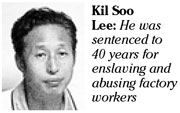
The Justice Department today announced the sentencing of the ringleader in the Department’s largest ever human trafficking prosecution. Kil Soo Lee, the former owner of an American Samoa garment factory was sentenced to 40 years in prison for his role in holding over 200 victims in forced servitude.
“Human trafficking is a moral evil that is nothing less than modern-day slavery,” said Attorney General Alberto R. Gonzales. “Today’s sentencing concludes the largest human trafficking case ever prosecuted by the Department of Justice and is another example of our commitment to protect the civil rights of trafficking victims. The Department of Justice will continue to pursue and prosecute all those who attempt to profit from human suffering.”
Lee, the owner of the Daewoosa garment factory, was convicted on February 21, 2003 of numerous federal criminal violations, including involuntary servitude, extortion and money laundering. Lee was charged in 2001, in the U.S. District Court in Hawaii, with illegally confining and using as forced labor over 200 Vietnamese and Chinese garment workers.
The workers were recruited from China and from state-owned labor export companies in Vietnam. They paid fees of approximately $5,000 to $8,000 to gain employment at the Daewoosa factory and risked retaliation and punishment at home if deported back to their native lands. Lee and his henchmen preyed on this vulnerability, and subjected the laborers to poor conditions and minimal pay. In March of 1999, after months of mistreatment, the workers complained about their plight and attempted to obtain food from local residents. Lee and his henchmen retaliated, using arrests, deportations, food deprivation and brutal physical beatings to force workers to operate the Daewoosa factory. In one episode, a woman was beaten so badly that she lost an eye. This abuse continued through November of 2000.
Kil Soo Lee was the third and last individual convicted in this case. In 2002, two of Kil Soo Lee’s co-conspirators, a manager and a garment worker, pleaded guilty to trafficking charges and were sentenced to 70 months and 51 months, respectively, in January 2004.
“Motivated by greed and with no regard for human dignity, these traffickers exploited more than 200 Vietnamese and Chinese workers,” said Bradley J. Schlozman, Acting Assistant Attorney General for the Civil Rights Division. “The Justice Department is firmly committed to ensuring that those who traffic in human lives are aggressively investigated, swiftly prosecuted and firmly punished. Today’s sentencing sends a clear message to those who would attempt to profit at the expense of another’s freedom.”
This case was prosecuted by attorneys from the Criminal Section of the Justice Department’s Civil Rights Division and was investigated by the Honolulu regional office of the FBI. The victim witness coordinator in the U.S. Attorney’s Office also assisted with the case.
(source: Department of Justice of Washington D.C.)
Video: https://www.youtube.com/watch?v=DObzMVNq-HE
ringleader: "cabecilla"
slavery: owning slaves
garment: clothing
laundering: "colada, lavado"
fee: "tarifa" "pago"
to prey on: (a person) victimize
plight: bad situation
to convict: "condenar"
to punish: penalty for offence
prosecute: "procesar"
witness: "testigo"
Summary
On June, 2005 was announced Kil Soo Lee's sentence: 40 years in prison. Kil Soo Lee was the boss of a garment factory called Daewoosa. This factory is located in American Samoa, a territory in the Pacific Ocean that belongs to United States. Kil Soo Lee received an important order from J.C Penny (a chain of stores really important in America) and this order was supposed to be complete in only two months. As a consequence, he had lots of workers from Vietnam, China and Samoa working in poor conditions: if the workers complained, they were punished with lack of food, pshysical abuse, detainment or deportation.
Although he had already been investigated in 1991, it wasn't until the plant was ordered by a Samoan court to be taken over by a receiver in 2001 that the FBI arrested Lee for involuntary servitude and forced labor. He was escorted to the District of Hawaii. His sentence on October, 2002 included 480 months in prison, over $ 1,500,000 in restituation payments and $1,400 in court fines.
Nowadays, twelve of those workers are now living in Washington State. The sentence was bittersweet for them because a Microsoft Corp. employee helped many garment workers move to the continental United States and have better lives.
David Enseñat, Cinthia Vargas and Marina Orfila
Domestic violence
No Charges In Stabbing Death
18-year-old Was Defending Mom
Victim's Family Upset
March 11, 1999|By KELLI CAPLAN Daily Press
HAMPTON — An 18-year-old Buckroe woman who used a steak knife to kill a man abusing her mother last month will not be charged in his death.
Linda Curtis, Hampton commonwealth's attorney, made the decision this week after reviewing the case. The evidence, she said, shows the teen-ager was trying to defend her mother against the "imminent threat" of bodily harm. By state law, that is what must be proven to justify the use of such deadly force.

"This was a violent confrontation going on between the mother and the victim," Curtis said. "She was entitled to use deadly force."
The family of the victim, Jesse Alphonzo Hogan, 44, is upset at Curtis' conclusion. They say someone should pay for Hogan's death.
"I don't think it's right," said Mary Washington, Hogan's mother. "That is cold-blooded murder. I don't understand what they are doing.
"I don't accept that," she said. "It's an injustice that they won't charge her. That's my child. Anyone who has had feelings for a child would be feeling the same way I do."
The 18-year-old, whose name has not been released, stabbed Hogan once in the chest on Feb. 27 at a home in the 100 block of North Fourth Street. She had grabbed the knife after seeing Hogan punch, slap and try to choke her mother before throwing her headfirst into a headboard in the bedroom, Curtis said. Hogan and the woman's mother had a long-standing intimate relationship.
Police found Hogan lying on the floor of an upstairs bedroom. The teen-ager admitted to the slaying, and police quickly located the knife. She could not be reached for comment.
It was the not the first time the teen-ager had witnessed domestic violence in the home. Since July 1996, there had been 22 911 calls made from the home, many of them domestic related, Curtis said. In 1997, the 18-year-old intervened in a dispute between Hogan and her mother and was assaulted herself, Curtis said.
Hogan's family does not dispute there were domestic problems between the couple. But, they said, that is no excuse for the lack of charges.
"What is Virginia trying to say?" said Reginald Morris, Hogan's brother. "They are saying that as long as a person has a history of domestic violence, they can kill him or her and get away with it. Virginia talks so much about domestic violence and its major plans to buck it. Yet when a homicide happens in a domestic-violence case, they say 'OK, he has a domestic-violence record, there is not reason to charge anyone.'"
Curtis said that is not true. She said she analyzed the evidence before rendering a decision. Bruises on the mother and signs of a serious struggle show the woman's mother was in danger, she said. "There is no evidence to suggest anything other than this happened," said Curtis.
The family's anger, she said, is understandable.
"This a tragic situation. There's no doubt about that," Curtis said. "I can certainly understand it from their perspective. My heart goes out to them. Their loss and grief are very real."
Hopefully, Curtis and domestic violence officials said, this case will highlight the need for the community to take domestic violence seriously.
"So many lives have been hurt and it just underscores how problems can build up," said Marcy Wright, associate director of programs at the Virginia Peninsula Council on Domestic Violence. "No one has to live in violence. No one deserves that."
Wright said she did not believe "it would be helpful to second guess the commonwealth's attorney." But she did say the case shows what the effect of abuse can be on children in the home.
It is not uncommon, Wright said, for children of abuse victims to take matters into their own hands.
"Often times they feel they have to protect the parent," she said. "She took the ultimate step in doing that."


Video
Summary
The news tell us an other sad case of domestic violence. The newspaper tell us about the non-stop maltreatment who suffered a woman by her partner. This tragic story ended with the abuser death when the daughter of the woman, who had been witness of several attacks from domestic violence, decided to stick a knife with such to defend his mother in one of these attacks.
Synonims
Attorney: lawyerEvidence: proof, testimony
Threat: manace, intimidation, intent to hurt
State law: legal system Harm: injure, damage of a State
Confrontation: hostile meeting, conflict, combat
Entitle: give right to (autorizar)
Upset: emotionally disturbed
Cold-blooded murder: emotionless killing
Charge: ask for money (cobrar)
To stab: gash, attack with a knife
Chest: bosom (pecho)
Grabbed: snatch, take hold of
Punch: strike, hit
Slap: hit with open hand (bofetada)
To choke: strangulate
Headfirst: recklessly
To slay: murder, kill
Reached: get to
Assaulted:Charge
Lack: shortage
Buck it: resist
Homicide: manslaughter
Rendering:execute
Struggle: difficult endeavour
Grief:sorrow
Underscores: emphasize
Build up: develop, reinforce
Deserves:merit
Guess:speculate
Núria Gibernau Mitjana and Elisa Alcaide Stumpf 2 bach. C
Suscribirse a:
Entradas (Atom)